SILVERLEAF FUNGUS : Chondrostereum purpureum
While not considered a health risk to humans, there are some rare cases of infection. See JPOST in the references below.
Its main concern is how it attacks plants such as roses.
Wiki tells us that It is is a fungal plant pathogen which causes silver leaf disease of trees. ..... The common name is taken from the progressive silvering of leaves on affected branches. It is spread by airborne spores landing on freshly exposed sapwood. For this reason some fruit trees are pruned in summer, when spores are least likely to be present.... [Wiki]
As with our example, it is often found on old stumps and dead wood, but it can also be a serious parasite of living trees. [Wiki]. It starts as little more than a crust on the rotting wood, the fruiting bodies becoming spread out as unified undulating brackets. The colouration is very distinctive with a pale edge until it eventually dries out to a drab brown.
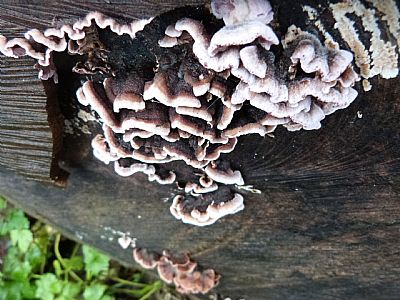
This example was found growing on a rotting log left after fallen trees were cut up in Boathouse / Fishers Wood several months after a storm.
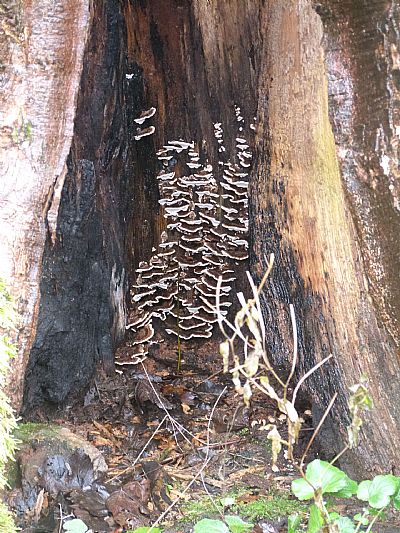
Another example seen nearby. This is within a treetrunk hollowed by past decay. This tree had survived for many years in spite of that internal decay, but eventually secumbed during the same storm in early 2025. The result was better conditions for such fungus.
JPOST / Jerusaleum Post (on human infection. https://www.jpost.com/science/article-736136
WIKIPEDIA : https://en.wikipedia.org/wiki/Chondrostereum_purpureum
WILDFOODUK : https://www.wildfooduk.com/mushroom-guide/silverleaf-fungus/