TURKEY RED : 12 - DALQUHURN DYE WORKS, Renton
ACCESS : You can easily get to parts of the lade. The site of the works itself is now under housing.
///daydreams.stuck.modest Incoming lade.
///doted.realm.portfolio Outgoing lade.
Also see DALQUHURN
The works was mainly within the meandering of the River Leven on one side and the lade formed to serve it on the other.
There are still a few signs of this works. The lade is still there although the section that flows through the housing has been heavily canalised with concrete. Gate posts remain within the overgrowth at the lower end of the site (downstream). A house that was outwith, but associated with the works, still exists off Johnson Road. Some of those houses that you can see on the map at the northern side of the site in Dalquhurn Lane were outwith the site and still remain in some form, either altered or replaced by newer ones.
You may note a "tomb" on the map. That is discussed under DALQUHURN BURIAL GROUND.
When the new housing was developed, the site was thoroughly cleared, stablised and raised both to avoid any residual contamination from the dye works and to avoid flooding. There is still an unused area that will one day be built on, but beyond it is what is shown on the old map as Dalquhurn Point.
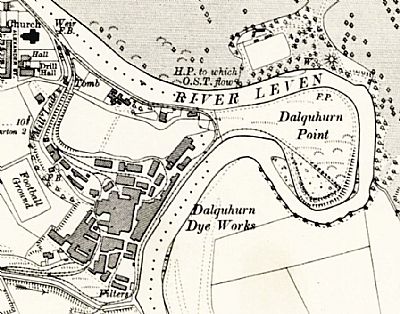
In this map of 1914, the works is well developed. You can make out the lade that still flows through the area, now housing (incoming -top left; outgoing - centre). NLS ©
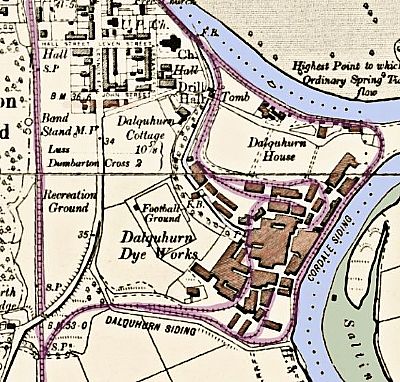
In this Ordnance Survey map of 1915 we see the works well served by railways, adding to those shown on the previous map - here overmarked in purple for clarity. Running north-south to the left of the map is the main line through Renton to Loch Lomond. A branch from that follows the Leven around to the site following the towpath. Sub-branches run within the site itself. NBR (North British Railway) is in colaboration with CR (Caledonian Railways) to serve the Vale of Leven. The "Saltings" refers to an area flooded at high water by sea water. The inflow of fresh water into the lade above this level was essential. NLS ©
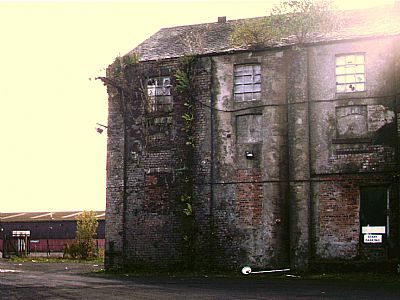
The following photographs were taken in 2006/7. One of the warehouses was used by a furniture shop. All of these buildings, except a house, have been demolished. The area is now occupied by the Dalquhurn residential development or remains vacant awaiting development.
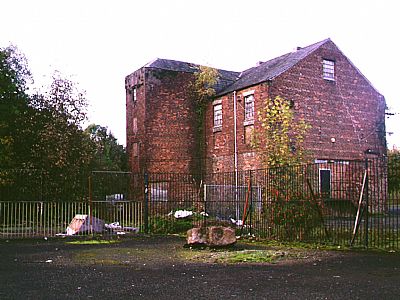
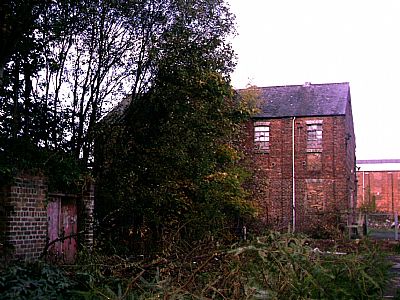
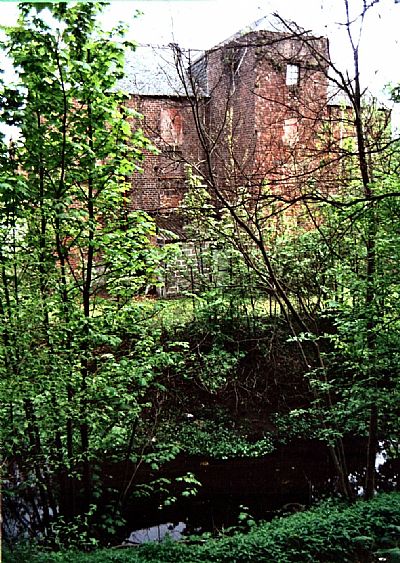
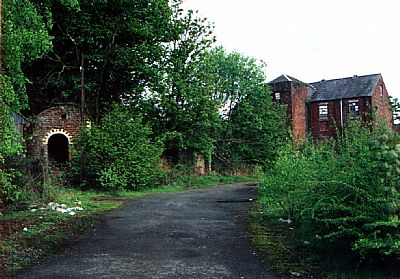
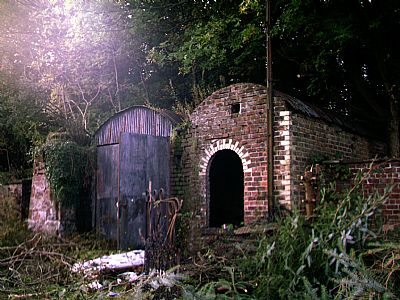
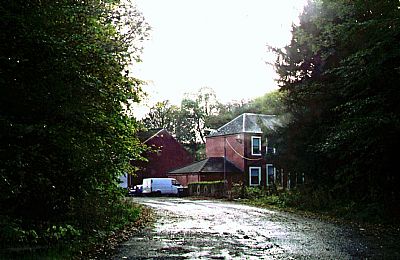
This house, Ladeside, remains although its outbuilding does not. It appears to have been the mill and not actually part of the dye works. Millstones can be seen built into the front boundary wall. The lade runs right behind it.
The following photographs are more recent including some taken in 2021.
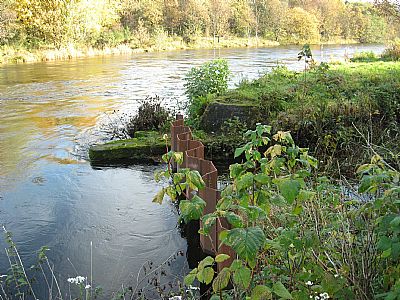
The inflow to which the weir directed flow from the Leven. The sheet piling was presumably intended to be a temporary barrier, but is still there.
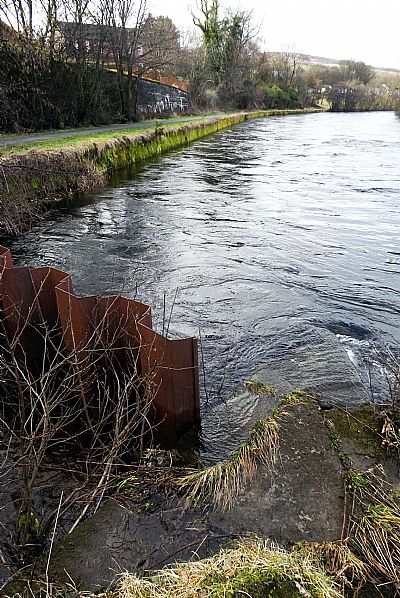
This is the inlet into the lade. Look for the weir on the map. For some reason efforts have been made in fairly recent years to obstruct flow. What water gets into the lade is largely incidental in spite of the piling sheets, but the result has been to make the lade water somewhat stagnant. The lade is also seriously affected by litter.
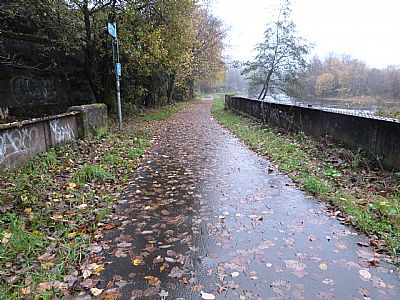
The lade passes under this low, but substantially built iron bridge which enabled the tow path to be fully utilised.
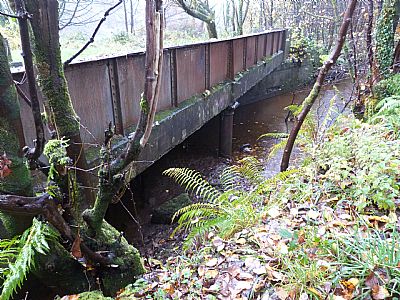
This is that same bridge seen from the lade.
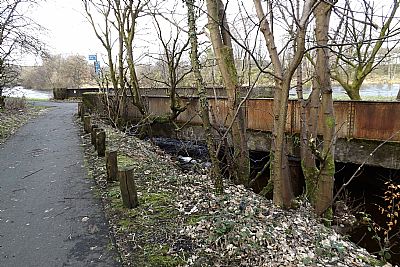
This photograph show the in-flow of the lade with a bridge over it for the tow path.
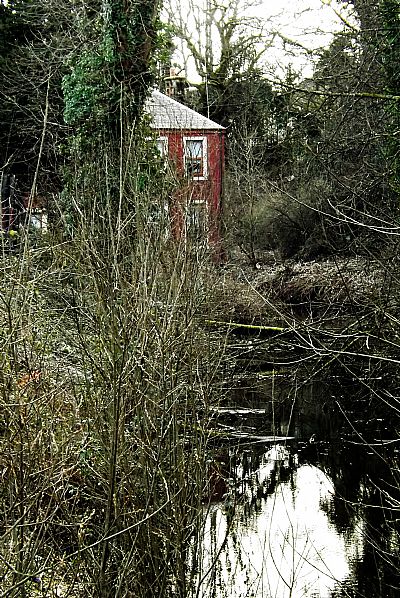
The lade leads under what is now Johnston Road and behind the houses. Above it is the eastern edge of Tontine. For this stretch it is much as it has been for years, picturesque and the home of waterfowl. That is Ladeside House in the distance. From that point on the lade turns abruptly to the left before returning to the Leven.
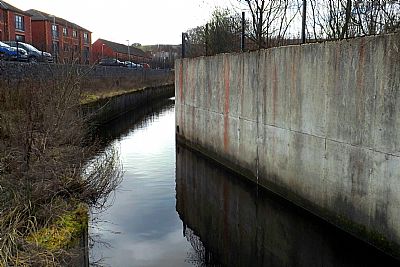
From where it turns back towards the Leven, the lade is now rather formidable. An opportunity missed? When the new housing was built, the land was raised to avoid any residual contaminants and to avoid extreme high water if the Leven floods.
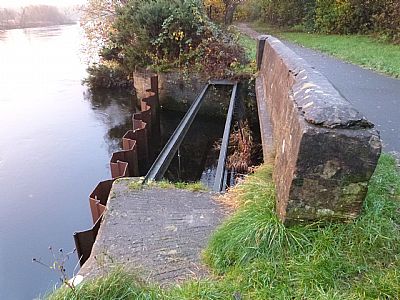
Where the lade flows back into the Leven it passes below a the towpath on a small stone bridge. You can see that some sort of sluice control existed by the grooves in the walls and a metal walkway, of which only the supports remain, was used to access it. As seen at the inflow, heavy steel sheet piling has been set to limit or even stop the flow.
We see an opportunity missed to better integrate this historic lade into the housing when the site was redeveloped. Further housing is being built as this is written in 2025. It is presumed that the sheet piling facilitated the rebuilding of the lade during the previous building phase along Johnstone, Taylor and Milllade and the other roads. The lade does not currently flow and has become somewhat stagnant. We wish to see the sheet piling removed at both ends to enable better flow and so improve the environmental qualities.
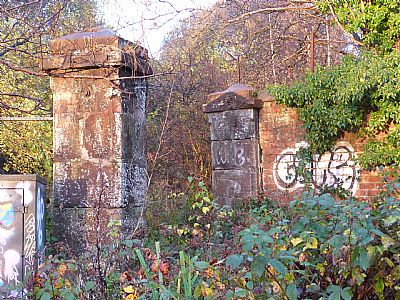
When you walk along the tow path you can still find these gateposts that stood sentinel at the corner downstream to the south. https://w3w.co/expanded.trespass.storyline
CANMORE : https://canmore.org.uk/site/128405/dalquhurn-print-works
GEOGRAPH.ORG : https://www.geograph.org.uk/stuff/list.php?label=Dalquhurn+Dye+Works&gridref=NS3977
NATIONAL LIBRARY OF SCOTLAND (NLS) : The maps here are reproduced with the permission of the National Library of Scotland.
1860 : Archive title : " Dumbartonshire, Sheet XVIII (includes: Bonhill; Dumbarton; Kilmar... Survey date: 1860 , Publication date: 1864". https://maps.nls.uk/view/74426619
1914 : Archive title : "Dumbartonshire Sheet nXVIII (includes: Bonhill; Cardross; Dumbart. Date revised: 1914, Publication date: 1923" : https://maps.nls.uk/view/75827346
NATIONAL MUSEUMS SCOLAND : https://blog.nms.ac.uk/2012/06/22/turkey-red-a-study-in-scarlet/
VALE OF LEVEN PROJECT website : http://www.valeofleven.org.uk/levenbridges.html
and http://www.valeofleven.org.uk/valeindustry3.html
WEST DUNBARTONSHIRE COUNCIL : Textile Industry in the Vale of Leven. https://www.west-dunbarton.gov.uk/leisure-parks-events/museums-and-galleries/collections/industry/textiles-and-mills/ and River Leven Heritage Trail : https://www.west-dunbarton.gov.uk/media/2619077/vale_of_leven.pdf
WIKIPEDIA : https://en.wikipedia.org/wiki/Turkey_red