
Cold Ashby’s History

(Image used under a Creative Commons Licence and obtained from here)
Quick Links:-
- For Cold Ashby's Domesday Book entries click here
- If you wish to view the Cold Ashby Register of Burials (1929 to 2017) try this link
- For 'History Beneath Our Boots' click here
- For descriptions of Listed Buildings in this area click here
- For Richard Knolles, Historian ( ?1540 - 1610) click here
- For the history of Cold Ashby Grange, Cold Ashby's 'official' ancient monument, click here
- For a 'Village Link' tribute to Cold Ashby's landgirls click here
- Access the Cold Ashby Militia List for 1777 here
- Get Cold Ashby's entry in 'British History Online' here
- For the Parish Council's 'Old Ashby' page click here
- For Dr.John Rogers MBE click here
- For Ashby Rambler's 'Chilcote Enquiry' into a local lost hamlet click here
- For those from Cold Ashby who served in the World Wars and history of the Memorial Village Hall click here
- For Some Notable Former Residents of Cold Ashby Hall click here
- For Dated Developments in Cold Ashby click here
- For some residents' memories of Everyday Life in the Early to Mid-Twentieth Century click here
- Historical Gazetteer and Directory entries for Cold Ashby can be read here
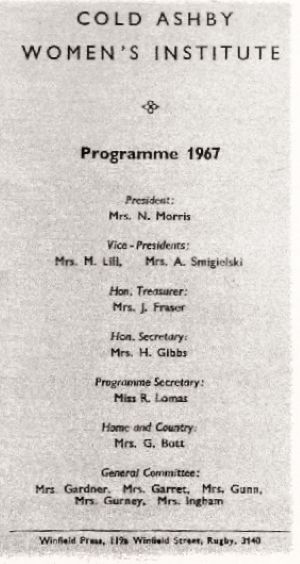
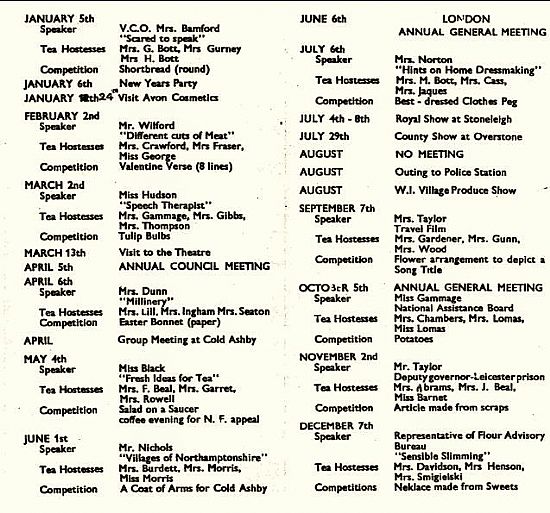
- For A Glimpse of Cold Ashby in 1966 & Women's Institute Programme 1967 click here.
- To read about Cold Ashby's response to the Covid Pandemic (2020 -?) go to Cold Ashby Rambler's Covid Chronicles.
- Use this link to view a collection of vintage postcards.

(Photo of St. Denys Church by Lottie Glascodine)
The Rambler would like to collect as much information as possible on Cold Ashby’s History and eventually assemble it in chronological order.
At present, the Rambler is still collecting, researching and grouping material so this is more of a 'miscellany' than the finished article!
For the Rambler's recently revised article covering prehistoric and medieval local history please go to History Beneath Our Boots.
For my observations on some of the events (some welcome, some less so!) during the last 15 years plus public responses to these you could go to my blog archive and click on 'index'.
All contributions, however small, are most welcome. Please use the Contact Page.

(Landscape View Publishers, Market Harborough - kindly lent by Diane Radford)
Fortunately, a superb document was produced for the Northamptonshire Rural Council in 1995. This was entitled ‘ Round & About Cold Ashby’ and pages from it follow.
The necessary acknowledgements are given first:


The Dyett family on one of their many camping holidays circa 1935-6:

The Rambler received this photo from Maureen and Olive, whom he met at The Black Horse Vegetable and Produce Show one September. From their notes, he offers this aid to identification:
Back Row
‘Scrom’ Tom Mcgeary, Alf Battison, ‘Pap’ Jim Dyett, Anon., Jim Dyett, Joe Dyett, Tubby & Frank Tite (camped in next field to Dyetts), Gus Bott
Middle Row
Hilda Dyett (Joe‘s Wife) , ‘Gran’ Sarah Dyett, Jack Man(n) (Publican, Black Horse) , Rose Dyett (Jim’s wife) Two Mrs Tites
Front Row
Olive Dyett ( daughter of Jim & Rose), Mick (Pap’s dog!), Frank Tite’s daughter.
The Rambler thanks Maureen and Olive for their memories and the notes sent with the photos.
Here is a (lightly) edited version:
The whole family camped at Cold Ashby for many years. Pap and Nora Jeyes had a boys’ camp first at Hemploe, around 1906 - 1908.Then the family camped at Gardener’s Farm from about 1920 - 1953. The men slept at the camp field and the women and children slept at The Black Horse.

The Black Horse was kept by Jack and Nancy Man (Mann?) , previously by the Merchants and before them it was the Sadlers (see photo).
The bakery (see photo above and information below*) was kept by Gyp Smith who cooked dinners as well as bread for the campers and villagers.
They were all a merry family and loved the camp - we all have happy memories of Cold Ashby.
The men, dogs and equipment all went on the lorry - an open-backed one. Hens and cockerels mostly making a one-way journey and ending up in the pot!
Women and children followed on Saturday morning, all meeting at the Mayorhold to catch the bus.
The Black Horse was the centre of the holiday and the villagers all came there to see the Dyetts, chat, catch up with news, drink a drop or two of ale and sing - a very happy time.
..............................................................................
*More on the Bakehouse

(Crabtree Lane, showing the bakehouse and cottages - thanks again to Janet & Ted Thompson)
According to Round & About Cold Ashby (p53), Mrs. Charlotte Smith, working with her son Charlie and his wife, supplied cakes and bread to customers in Naseby and Haselbech as well as Cold Ashby - initially by horse and cart and ‘later by motorised van’.
They became famous locally for the cream horns they baked during the Second World War.
Charlie is said to have made night-time deliveries by throwing loaves through bedroom windows, the recipients having retired for the night. He also, apparently, delivered local youngsters to neighbouring village dances, in the van, without charge.
.............................................................
Was Church Lane once a B Road?

[from p.112 National Road Atlas, A. Thomas & Co. (no date given)]
Those who know Cold Ashby will notice that, on this map (of uncertain date - but certainly in use by my father in the 1950s!) the former B 4036 appears to avoid Main Street altogether.
This is probably a cartographic or printing error - but exercises the imagination.
...................................................................
A Topographical Dictionary of England, ed. Samuel Lewis (London, 1848) has the following:
ASHBY, COLD (St. Denis), a parish, in the union of Brixworth, hundred of Guilsborough, S. division of the county of Northampton, 11½ miles (N. W. by N.) from Northampton; containing 443 inhabitants. This parish, which comprises by computation 2077 acres, forms a verdant tract of elevated ground, and is traversed on the north-east by the road from Northampton to Leicester. From the bold declivity terminating the lofty ridge upon which the village stands, extensive and beautiful prospects are obtained of the surrounding country. The living is a vicarage, valued in the king's books at £6. 0. 5.; net income, £230; patron and Ashby, Cold (St. Denis)incumbent, the Rev. W. Mousley; impropriators, the family of Buxton: the glebe consists of about 120 acres of good arable land. The church was repaired and repewed in 1840, at which time the incumbent presented a new organ and two stained-glass windows. Here is a school endowed with £18 per annum, and with £6 arising from land. Richard Knowles, the historian of the Turkish Empire, was born here in 1540.
Source:
'Ashbury - Ashchurch', in A Topographical Dictionary of England, ed. Samuel Lewis (London, 1848), pp. 81-85. British History Online http://www.british-history.ac.uk/topographical-dict/england/pp81-85 [accessed 15 April 2018].
The extract below is from:
'The History Gazetteer and Directory of Northamptonshire etc' 1849.
(William Whellhan and Co. , January 1, 1849, Whittaker and Company)
ASHBY COLD PARISH.
Ashby Cold, or Cold Ashby, is bounded on the east by Naseby parish, on the north by Welford, on the west by Winwick, and by Thurnby (sic) on the south. It contains 1,940 statute acres; its population, in 1801, was 379 ; in 1831, 385; and in 1811, 443 souls. The rateable value of the parish is £2,878; and the amount of property assessed for the property tax, in 1815, was £3,211.
It is called Essebi in Doomsday book, and, from its high and exposed situation, has since been called Cold Ashby.
The Village of Cold Ashby, which is neat and healthy, stands on a verdant tract of elevated ground, stretching along the north-western verges of the county, about 115- miles N. N. W. from Northampton, and 6 from the Crick Station of the London and North Western Railway. There is a perennial spring of soft water in the village, which forms one of the sources of the river Nen (sic), and flowing down the above valley meets with other streams ...
The Church, dedicated to St. Dennis (sic), is a small ancient edifice, supposed to be originally Norman, the remains of a Norman arch being discernible on the north side. It consists of a body or nave, chancel, south porch, and a low embattled tower, in which are three bells. One of the bells, which is very ancient, and is said to have been brought from Sulby Abbey, bears this inscription in Gothic capitals, MARJA VOCOR ANO DNJ. MCCCXVII. The font is massive, and very beautiful. The church was repewed and thoroughly repaired in 1840, under the direction of the present patron and incumbent, the Rev. William Mousley, M.A., who presented it with an excellent organ, and whose lady gave two very neat stained glass windows. A splendidly bound set of books for the desk, was presented at the same time by Joseph Faun, Esq. The living is a vicarage, in the deanery of Haddon, rated in the King’s books at £6. 0s. 5d, and in the parliamentary returns at £131. 4s., gross income £230.
The Rev. William Mousley, M.A., the incumbent of this parish, is the author of a useful work, entitled, “ Moral Strength.” The glebe land consists of 119 acres.
The Vicarage House, which is a commodious residence, stands near the church, about the centre of the village.
There is an Independent Chapel in the village, and a Free School for poor children, which has an endowment of £18 per annum, arising from property left in 1710 by William Wickes, and £4. 105. bequeathed by Richard Ward, in 1736. The church land of the parish produces a yearly rent of £15. 16s. 2d.
Andrew Thomas, baker
Beale Joseph, carpenter
Cherry W., builder &. grocer
George John, shopkeeper
Guy Joseph, schoolmaster
Haddon Mr. Lawrence
Johnson Mr. Thomas
Lovell William, Esq.
Loydell Edward, blacksmith
Marlow Charles, carpenter and wheelwright
Moss Thomas, shoemaker
Mousley Rev.William (vicar)
Pain W., (vict.) Black Horse
Parker George, baker, &c.
Perkins William, carpenter
Webb Samuel, blacksmith
Westerbury T., carpenter
Wykes John, shoemaker
Farmers & Graziers.
Attfield David
Biggs William
Bryan Thomas
Denny Samuel
Dunmore William
Eames John
Gilbert Joseph
Peale Martha
Underwood Thomas
Wright Christopher
Wright John and William
Letters received through the Post Office, Welford.
Carrier to Northampton.——Rd. Cattell, on Sat.
...................................................................................................................
Wright’s Directory 1874
Ashby Cold, or Cold Ashby, is bounded on the East by Naseby parish, on the North by Welford, on the West by Winwick, and on the South by Thornby. It contains 2077 acres; its population in 1801 was 379; in 1831, 385; in 1841, 433; in 1851, 467; in 1861, 444; and in 1871, 402 souls.
The rateable value of the parish is £3,074, and the gross estimated rental £3,605.
It is called Essebi in Domesday Book, and, from its high and exposed situation, has since been called Cold Ashby.
The quality of the soil is good, and chiefly of a loamy nature; there is some excellent grazing also corn land. The ground towards the South is undulating, and a valley commences close to the village, which winds along by Guilsborough towards Northampton. The principal proprietors of the soil are: Robert Blencowe (lord of the manor) George Buxton, Isaac E. Lovell, Samuel Walker and theTrustees of Christ's Hospital ....The Village of Cold Ashby occupies a healthy situation on a tract of elevated ground stretching along the North-Western verges of the county, about eleven and a half miles North-North-West from Northampton, eleven North-East from Daventry, nine South-West from Market Harborough, and six from the Crick Station of the London and North-Western Railway.
There is a perennial spring of soft water in the village, which forms one of the sources of the river Nene, and flowing down the above valley meets with other streams, especially one rising in the village of Naseby, two and a half miles distant, and which is another of the chief sources of the Nene.
The Church, dedicated to St. Denis, or St.Dionysius, is a small ancient edifice, supposed to be originally Norman, the remains of a Norman arch being discernible on the North side. It consists of a nave, chancel, and a low embattled tower, in which are three bells and a clock. One of the bells, which is very ancient, and is said to have been brought from Sulby Abbey, bears this inscription in Gothic capitals, MARIA VOCOR ANO DNI. MCCCXVII. The font is massive and very beautiful. The church was restored in 1840, under the direction of the late patron and incumbent, the Rev. William Mousley, M.A., who presented it with an organ. A handsomely bound set of books for the desk was presented at the same time by Joseph Faux, Esq.
The living is a Vicarage in the deanery of Haddon, rated in the king’s books at £6, Os.5d., and now worth £280 per annum. The Rev.Gregory Bateman, MA., the incumbent of this parish,is the author of 'Sacred Poems', etc. The glebe landconsists of 120 acres. The church land of the parish consists of six acres, producing a yearly rent of £21-10s., which is expended in the repairs of the church.
Post Office - Wall Box. Cleared at 5.20pm ; letters via Welford.
Askew John, shopkeeper
Attfield David, butcher & farmer
Bateman Rev. Gregory M.A., vicar
Beal George, baker
Beal John, carpenter & grzr.
Bennett Charles Wm. vict., Black Horse
Buckingham Miss Susannah, schoolmistress
Cattell Mr. Richard
Cherry Wm., carpenter & shopkeeper
Eames John, vict. Bull, & farmer
Haddon, Mrs. Ann
Haddon David, higgler and grazier
Jeffs Wm. Haddon, shopkeeper
King Samuel, butcher & farmer
Moss Thomas, shoemaker
Odd George Wm., butcher
Perkins Wm., wheelwright & carpenter
Rigby Mrs. Emma
Rigby Mrs. Mary
Walden Wm., gardener
Watts Thos., bricklayer & builder
Webb James, blacksmith
Wickes John, shoemaker
Farmers and Graziers:
Ashby Edward
Burdett Samuel
Carvell Joseph
Dexter William
Gilbert Joseph (yeoman)
Gilbert William, Lodge
Parker George
Wright William and John
Carriers - James Walden and David Haddon to Northampton on Saturday and Samuel King on Wednesday and Saturday.
(NORTHAMPTONSHIRE PARISH 2000, ROUND AND ABOUT COLD ASHBY p.6)
........................................................................
Wright's Directory 1884
COLD ASHBY (anciently called Cole Ashby), is a parish, village, and polling place for the Southern division of the county, hundred of Guilsborough, Union of Brixworth, rural deanery of Haddon, County Court district and Archdeaconry of Northampton, 12 miles N.W from Northampton, 11 South East from Rugby, 11 North-East from Daventry, 10 South from Lutterworth, 9 South-Westerly from Market Harborough, and 41/2 South-Easterly from the Yelverton (sic) station on the Rugby and Stamford branch of the L. & N.W. Railway.
The village is situated on a lofty plateau, from which very beautiful and extensive views may be obtained of the surrounding country. The river Nene, it is said, takes its rise from the soft water spring on the Western side of the parish.
The church of St.Denis is an ancient stone edifice, chiefly Early English, but containing several Norman decorations. it comprises chancel, nave, with vestry on the North side, South porch, and Western tower containing four bells. The vestry was built in 1882, at a cost of £75, chiefly out the church funds.
In 1877 a handsome brass was placed on the North wall by the rector to the memory of his mother, Mrs. Mary Peake, of Norfolk villa, Surbiton. In 1880 a superb white marble tablet and stained window were erected, and the fourth bell was presented in memory of Mrs. Bateman, wife of the rector. The rector also started a subscription towards the restoration of the church, which is much needed.
It is proposed to take away the unsightly Western gallery (opening the tower arch), and box pews, to restore the tracery of the windows, renovate the stone work generally, and to re-seat the church with open benches. The churchyard also needs improvement, but the rector has done his part towards its embellishment by the erection of a magnificent stone Lychgate...
...70 tons of stone were used in the construction, which has been creditably carried out by Messrs. Allsopp and Monk, of Market Harborough, Mr. W Cherry, of Cold Ashby, acting as clerk of the works. The designs and plans were prepared by Mr.John A. Hanley, of Chester, from a draught design sketched by the donor. The cost was about £400. It was opened October 23, 1883, the Ven. Archdeacon Braim and other clergymen taking part in the service...
Post Office -
Ward Attfield, receiver. Letters from Rugby through Welford delivered about 8.30am ; box cleared about 5.20pm on week-days only. The nearest Money Order and Telegraph Office is at Guilsborough.
Bateman Rev Gregory, M.A., vicar
Bennett Chs. Wm., in Black Horse
Cattell Mr. Thomas
Cheney Edwin, baker
Cheney John, agricultural machinist
Cheney Jonas, cottager
Cherry & Vesty, bldrs & contractors
Emerton Miss Frances, mistress of
Board School
Gilbert Mrs. Sarah
Illson Coles, miller, h Naseby
Jameson Mr. Thomas M., Cold Ashby hall
King Samuel, cottager and carrier
Perkins Mrs. Mary, dressmaker
Vesty John, of Cherry & Vesty
Watts Thomas & Sons (Walter and Frank),
bricklayers & builders
Webb James, blacksmith
Wickes George, cottager & Bootmaker
Farmers and Graziers -
Beal John, grazier
Douglass James Heger, h Market Harborough
Eames Mrs. Ann, and v, Bull
Gardner William
Gilbert Fdk, Edwin, Ashby lodge
Gilbert James, and landowner
Swingler Thomas, bailiff to Mr. Douglass
Underwood Edward
Wright Mrs. Maria
Carriers -
Haddon David, to Northampton WS.
King Samuel, to Northampton S.
Walden James, to Northampton S.
Walton Mrs. from Northampton, through
Crick to Market Harborough,Tu.
Grocers and Shopkeepers -
Attfield Ward, and cottager, PO.
Cherry William, & 0f Cherry &Vesty
Martin John
(NORTHAMPTONSHIRE PARISH 2000, ROUND AND ABOUT COLD ASHBY p.7)
...................................................................................................
Kelly's Directory 1910
COLD ASHBY is a parish and village on high land adjoining the road from Northampton to Leicester, 5miles south-east from Yelvertoft station on the Rugby and Market Harborough section of the London and North Western railway and 6 3/4 west from Brixworth station, 12 north-north-west from Northampton, 13 south-east from Rugby, 11 north-east from Daventry, 10 south from Lutterworth and 9 south-west from Market Harborough, in the Mid division of the county, hundred of Guilsborough, petty sessional division and county court district of Northampton, union of Brixworth, rural deanery of Haddon (first portion), archdeaconry of Northampton and diocese of Peterborough. The parish is watered by the Stowe brook, a feeder of the river Nene. The church of St. Denis is a building of stone in the Early English style, consisting of chancel, clerestoried nave, south porch and an embattled western tower with pinnacles, containing a clock and 4 bells, one of which was added in 1883 by the Rev. Gregory Bateman M A. vicar 1871-91, and another bears the inscription " Maria Vocor,.Ano. Dni. MCCCXVII: " the font, a work of early date, Is hewn from a single block of basaltic granite : on the south wall is a sun-dial, with the date 1703: the porch is dated1696 : there are two modern stained windows, a brass erected in 1877 to Mrs. Mary Peake of Surbiton, mother of the Rev. G. Bateman, late vicar, and a mural tablet to his wife: the organ was presented by him in 1873, and in 1883 he erected the lych gate, at a cost of £400, as a further memorial to his wife: the vestry, built in 1881, incorporates in its doorway part of a Saxon arch: the church was generally repaired in 1840, and will seat 150 persons. The register dates from the year 1560. The living is a vicarage, net yearly value £130, including 119 acres of glebe, with residence, in the gift of Miss Mousley, and held since 1891 by the Rev. James Flamank B..A. of Keble College, Oxford. The cemetery of about half an acre, opened in 1879 is managed by the parish meeting..A sum of £18, derived from land left in 1710 to the vicar for the time being by William Wicks, of Wandsworth, London, is for catechising the children of the parish in church. Ward's charity of £4 10s, yearly is for the tuition of poor boys of the parish.The church land produces £11 yearly for church purposes. Robert Campion Blencowe esq. J.P. of Bineham, Chailey, Sussex, who is lord of the manor, John Buxton esq. Major Leslie Renton, Isaac Edward Lovell esq. of Guilsborough, Mr. Stephen Matthew, the governors of Christchurch Hospital and the vicar are the principal landowners. The land is arable and pasture. The soil is chiefly light and sandy; subsoil, chiefly shale and in some parts gravel The area is 2,022 acres of land and 37 of water; rateable value, £2,375; the population in 1901 was 258.
Sexton, Walter Cave.
Post Office. Jesse Allan Johnson, sub-postmaster. Letters from Rugby through Welford at 8 a.m. & 12.15p.m. (callers only) & dispatched at 5-45 p.m. on weekdays only. Thornby, I mile distant, is the nearest money order & telegraph office.
Public Elementary School (mixed), erected, with house for the teacher, in 1867, on a site given by the Rev.William Mousley M.A. vicar from 1829, & conveyed to the vicar & two churchwardens in perpetuity: this building is now let for a nominal rent to the County Council, & will hold 100 children; average attendance, 37; Mrs. J. F. Smith, mistress.
Carrier to Northampton – John Dunmore
PRIVATE RESIDENTS.
Flamank Rev. James B.A. (vicar),The Vicarage
Hazlehurst Thomas Francis D.L., J.P. The Hall
Rigby Mrs. Emma
COMMERCIAL.
Beal Edwin, grazier Haddon
Beal Richard, grazier
Burdett Frederick, grazier
Cave George, farmer, Reservoir farm
Cemetery (Jesse A. Johnson, clerk to the Parish Meeting)
Litchfield Martin, farmer, The Cedars
Day William, jobmaster
Dunmore John, Black Horse inn
Gardner George, farmer
Gilbert Sarah (Mrs.), Bull inn
Gunn Alfred, butcher
Isaacs John, farmer, The Laurels
Johnson Jesse Allan, carpenter,Post off.
Lee Randall, blacksmith
Lill John, farmer
Matthew Stephen, farmer, Manor Farm
Miller Charles Wm. baker & grocer
Miller Mabel (Mrs.), shopkeeper
Smith Charlotte (Mrs.), baker
Watts Albert, builder
White William farm bailiff to G G Atterbury Esq. Of Manor House, West Haddon
Wickes George, cowkeeper
.......................................................................................................
Green Lanes in Cold Ashby Parish
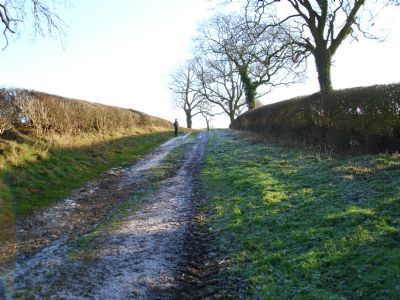
There are three of these former highways in the parish.
Of these two are named ( Bridle Lane and Carvell’s Lane) and the third forms the connection between West Haddon Road and the Jurassic Way (see the ‘Rambler’s Favourite Walk’ on the Local Walks page.)
The Rambler recently turned up the following reference to what appears to be the Cold Ashby to Winwick Byway in the Journal of the Byways and Bridleways Trust. The article, Valedictory for a Principle, from which this is extracted, deals with the unlawful diversion of a common highway. If, as this seems to suggest, the byway was in use well before 1631 then it certainly qualifies as an ancient right of way!
For clarity, it should be explained that, in 2001, the acronym BOAT was used to denote a 'Byway Open to All Traffic' :
The use of the writ of ad quod damnum was the only means of a lawful diversion in 1631.
In R v. Warde and Lyme, CRO. CAR. 266, the defendants stood accused of unlawfully stopping and purportedly diverting Crick Lane in Cold Ashby [this may well be the BOAT shown in Landranger sheet 140, just to the northeast of Winwick (GR6273)] which is described as “… from the time whereof, etc., [presumably ‘the memory of man runs not to the contrary’] a common highway … leading to divers market-towns, as well for horsemen as for footmen and for carriages…” and this is “… so foul, and surrounded with water and dirt, that passengers could not pass there without great danger…” The Attorney General argued that although the new way may be more “beneficial”, without the essential writ “… the inhabitants are [not] bound to watch there, or to make amends if any robbery be there committed, nor is any person liable to repair and maintain it…” Held, the ‘diversion’ is unlawful.
(2001/5/28 Byway and Bridleway, Journal of the Byways and Bridleways Trust)
Bridle Lane was once Cold Ashby’s local route to Welford ( see Local walks page). It is now cut short by the A14 but it is still possible to walk and ( with care!) ride between the villages, thanks to connecting rights of way organised by the Northamptonshire Rights of Way team.
According to ‘Round and About Cold Ashby’ the highway has been used for about 600 years. Certainly, a ‘hollow way’ is clearly visible passing from Bridle Lane, through Grange field, to the present Naseby Road. The present right of way does not include the ancient way, instead crossing almost diagonally from the gate off Bridle lane to the gate opening on to the verge of the Naseby Road. The advantage of this, however, is that the modern footpath allows a closer view of the scarps, banks and closes of the medieval grange which gives the field its name.
The grange* was attached to Pipewell Abbey and according to Bridges’ The History and Antiquities of Northamptonshire (1791), cited in ‘Round and About Cold Ashby’, some of the building was standing just over 200 years ago.
As far as I know, the Grange Field has never been the subject of archaeological investigation but I believe ploughing of the area is forbidden.
This suggests it has value as a site.
* Update : The Grange is now listed as an 'Ancient Monument' (see top of page).
......................................................................
Cold Ashby Industry
There was a steam mill on the site now occupied by Mill House. The engine is believed to have been installed at the eastern end of the present building. That the mill was still there at the beginning of the Twentieth Century is evidenced by several papers in my possession.
On 23rd June 1866 Nehemiah Ilston Coles of Naseby bequeathed :
…his steam mill site … in Cold Ashby in the County of Northampton …with the steam engine, boilers, millstones, tackle, fixtures & appurts. Thrto (sic)
to Priscilla Coles, who, in turn ( if my interpretation of some rather obscure “legalese” is correct!) bequeathed the mill etc. to Thomas Leeson in 1899.
On the 17 September, 1904 an indenture was made conveying:
…a piece or parcel of ground…together with the steam mill, engine house, stable and outbuildings erected thereon …
from Mr N.I. Coles and Mr. T. Leeson to Mr. George Townley.
Illson (sic) Coles is listed as Illson Coles, miller, h Naseby in Wright’s Directory of 1884.
Mill House has recently been sympathetically restored and extended but the elevated section at the eastern end shows where the former steam engine was probably housed. The former 'Journeyman's Cottages', referred to above, are now known as Mill Cottage and Mill House Cottage and incorporate five of the original dwellings - the sixth, at the eastern end of the row, having been demolished.
The Smithy was originally operating just a few paces down Main Street from the Mill. The building remains on the corner of Crabtree Lane, having only recently been converted, again most sensitively, into a pair of garages for the associated cottages. Round & About Cold Ashby states that it was built around 1900 at a cost of £40 by Palmers of Yelvertoft* and that Randell Lee and later his son, William Lee continued the business until 1954.
Randell's grandson, Billy Lee, is remembered in the newly built 'William Lee Close' off
Crabtree Lane.
*Palmers were a well-known local firm who employed as many as 60 men on various building projects including much work at Winwick and Stanford Hall, also they built a Roman Catholic Church at Eton for Lord Braye c1913.
.....................................................................
The Church
No compilation of historical notes on Cold Ashby would be complete without mention of the Church of Saint Denys, believed to date from the Twelfth Century.
A fine, illustrated history of the church is available on the Parish Council’s Website.
For regularly updated details concerning the church and its place in the life of our community click/tap HERE.
**Update: From Monday 2nd March 2015 the Church should be open to visitors from 9.00am to 5.00pm each day.
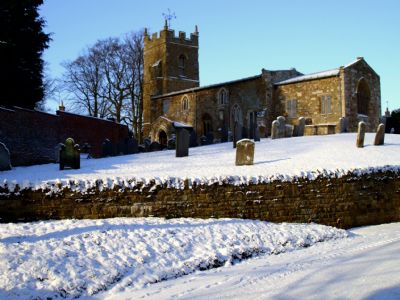
There are also some fine, detailed photos available on this excellent blog.
Best Kept Village Competition
On display in the church are several items and photos of historical interest amongst which are the framed certificates which proclaim Cold Ashby's fine performance in the Best Kept Village Competition 1990- 1993 pictured below...
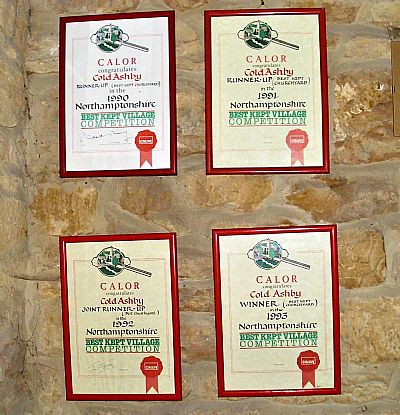
'Round & About Cold Ashby' also records the fact that the 'Best Kept Churchyard in Northamptonshire' was won by Cold Ashby 7 times between 1974 and 1993 and in one year (1993) we held the 'Best Kept Village', 'Best Kept Churchyard' and 'Tidy Village titles' simultaneously!
...............................................................
Cold Ashby and The Battle of Naseby
The Rambler has recently discovered the following on this website, dedicated to the letters of Thomas Carlyle. The writer is Edward Fitzgerald:
"Borough Hill is to be seen from a spot close to Cold Ashby. I hear of traces of an army passing through Cold Ashby, but not through Thornby, which is the more direct road from Guilsborough to Naseby: But neither are the directest road, as you will see by any map. I should therefore suppose that it was more probably the Royalist than the Parliament army, since Cold Ashby certainly lies between Borough Hill and Naseby. One story indeed yet extant at Cold Ashby tells of both armies: that the Royalists were busy eating the good man's bacon at the Inn, in his absence: he returned suddenly, and the fellows asked him where the Rebels were: he said, close behind him: on which they decamped and he saved his bacon. Between Cold Ashby and Guilsborough … were found—in a gravel pit—two perfect skeletons of soldiers sitting, rather hunched together: their helmets sticking to their skulls, and bits of chain (like curbs of bridles, I was told) still remaining"
Carlyle replied with the following observation:
'The Cold Ashby tradition is likewise very credible, almost probable. For Ireton with light horse hung all that Friday morning upon the King's rear, scuffling with them; finishing off his day's work at Naseby, on Langdale's Northern Horse. It is as good as certain the King would go thro' Cold Ashby,—I suppose he was marching on all the practicable roads that led up towards Harborough; Ireton keeping him close company on the main road. Ireton therefore we conclude was the saviour of the Ashby bacon: he would not eat it without paying for it! The two sitting skeletons of troopers would most likely be killed in this skirmishing pursuit;—and the chance rather is, since they were not stript, that they might be soldiers of his own; buried by their friends, pushed into any hole, and at least hidden from insult? Or perhaps not so? One would have liked to see the traces of the inscription on their caps! The "bridle-chains" were probably chin-straps for keeping their helmets on.— Fairfax, as I interpret, would not go thro' either Thornby or Cold Ashby, on Saturday morning, from Guilsburough; but straight up by the nearest road and roads he could fall in with. He took two hours: from 3 till 5 in the morning.'
(Full references and dates are given at Carlyle Letters Online).
As you will find when visiting this excellent website, the anecdote above was recorded in 1842, virtually 200 years after the alleged event.
It would be most interesting to hear from anybody out there who has the tale from another source. If you have please use the Message Board.
An excellent self-guided tour and map of the significant sites, which also explains the movements of the troops and the changing fortunes of each side in the Battle of Naseby can be found here.
The Rambler would also recommend ' Naseby - June 1645' in the Battleground Britain series (Leo Cooper, 2002).
.............................................................
Farming and Agriculture 1940- 2000
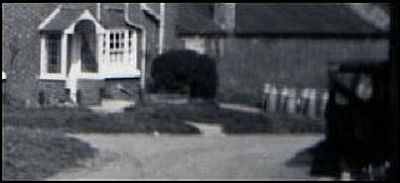
Mil((M(Milk churns outside Manor Farm can be discerned on the right of this detail from the postcard appearing above.)
The article below appears on page 17, Round & About Cold Ashby (Northampton Parish 2000, pub. May 1995)
Prior to the second World War, the majority of the land in the parish ( Cold Ashby) was permanent pasture. The few fields of arable land grew crops which, in the main, were used to feed the livestock during those times in the year when the pasture would not support them. All this changed in the war, however, and the government directive that the country must be self-sufficient in food production, saw the beginning of the larger arable acreage. Wheat, Barley, Oats, and Potatoes, together with stock-feed crops such as Mangolds, Swedes, and Kale appeared in fields which had been permanent pasture for decades.
The advent of arable machinery and the progressive increase in their size, began to change the face of the countryside, not only locally, but countrywide. The removal of hedges and trees to accommodate the larger machines and to provide more land for production; major drainage schemes which saw many ponds and ditches vanish; and the amalgamation of small farms into larger units, dramatically changed the traditional farming methods in Cold Ashby.
The parish consists of 2075 acres 2 rods 29 perches. In the early 1950’s there were fifteen full-time farmers, employing a large part of the village work-force. All these farms were mixed stock and arable, having cattle, sheep, pigs, poultry, and corn. Eleven farmers produced milk, which was collected daily in 10 gallon churns (see photo above). The cattle, sheep, and pigs were sold mainly at markets in Northampton, Rugby, and Market Harborough. Eggs were collected from the farms each week, and cockerels, turkeys, ducks, and geese were fattened for the Christmas trade.
By the mid 1980’s there were nine farmers left on the same land, much of which had been amalgamated into larger units with other farms outside the parish boundary. Only four village residents were now employed on these farms. The majority of the land was arable, producing Wheat,Barley, Oats, Oilseed Rape, and Beans. A dramatic change in stock-farming, saw the disappearance of all the dairy cattle, pigs, and poultry; only sheep and beef cattle remained.
Economics, and the maximum food production policy of the 1960's, dictated the changes in this 30 year period of commodities within the European Community Countries, and the awareness of environmental issues, has seen the introduction of the ‘set a side’ policy and the planting of trees and alternative crops, such as Linseed.
The traditional permanent pasture land of the 19th and early 20th centuries, has all but vanished with perhaps as little as 50 acres remaining. Much of this is now within the area of the Golf Course.
For earlier agriculture and related settlements see History Beneath Our Boots.
.......................................................
.........................................................
Second World War Evacuees in Cold Ashby
'Round & About Cold Ashby' states that the first evacuees arrived in Cold Ashby the day after the declaration of war, having been relocated after a few days in Rugby.
They were assembled on the school playground to enable villagers to make their choice and the teachers who accompanied them stayed at The Laurels.
Lessons were initially taught in the Memorial Hall but the children were later enrolled at Thornby or Cold Ashby Schools.
A photograph of evacuees 'admiring' local pigs was published in 'Round & About Cold Ashby' and is now available at this link.
The description of the photo suggests that the children were mostly from Dudden Hill School in Willesden and that Les Swaffield was one such evacuee.
.........................................................
'Dated Developments'
The following meagre list is an attempt to record historical ‘milestones’ in the development of our village community - much is gleaned from Round & About Cold Ashby (1995) , some ( but not nearly enough yet!) from oral history.
There are obvious gaps, missing dates and probably inaccuracies or errors.
If you have any further information, or wish to supply dates, make corrections etc., please contact the Rambler.
As previously stated, this page is under continuous development.
Local Government
- Parish Meetings began 1912
- Parish Constables Elected 1913
- Parish Council formed 1949
- Changed to Daventry District Council from Brixworth RDC 1974
- Neighbourhood Watch 1988
Main Services
- First telephone installed in The Hall 1928
- Public telephone installed on The Green 1930
- Electricity supply to village 1930
- Mains Water supplied from 1947
- Mains drainage, replacing previous system with a treatment plant behind Home Farm, installed in the 1960s
- Street Lights installed 1950 , all-night lighting 1987
- TV mast proposed for Honey Hill 1959
- Postal address changed to Northampton (formerly Rugby) 1973
- Post box moved to The Green (from wall of former post office) 1976
- Postal deliveries from West Haddon ceased 1979
- Village Post Office/Shop ceased trading 1991
- Village School built 1867, closed 1970
- Smithy built c. 1900 (for £40!), last used as such 1954
- A14 (A1/M1 Link) Road opened 1994
- Surface Water Drainage improved 2015
- Superfast Broadband access points installed 2016
- Defibrillator installed in Telephone Kiosk 2018 (telephone removed!)
- LED street lighting installed 2020
Church
- Present building (without tower) probably 12th Century, restored circa 1840
- Tower added 15th Century
- New cemetery opened for burials 1880, consecrated 1971
- Lych Gate 1883
Chapel
- Founded 1710 but thought to be closed by 1850
- Wool barn in Crabtree Lane given for use as a Congregatonal Church in 1860
- Consecrated 1943
- Closed circa 1980
Monastic Grange
- ?13th - 16th centuries : see Cold Ashby Grange
Shops
- Post Office operated at Mill Cottages until 1960 then from Church Lane as Post Office and shop, closed 1991
- Village Shop and Bakery in Crabtree Lane (ceased baking in 1970s)
- Bakery in Church Lane until late 1970's
Pubs
- The Black Horse (closed 2020 during Covid Crisis)
- The Bull Inn (still marked as such on a map dated 1963 but now a private house) believed also to have had a bakery
Industry
- Steam Mill off Main Street (now Mill House)
- Smithy in Main Street
- Lampshade Factory (now Mill Cottage)
- Dairy in Church Lane
- Winwick Wind Farm (operational from 2016)
Farms (as listed in 1995)
- Bunkers Hill
- Cedars
- Coe
- Cold Ashby Lodge
- Litchfield
- Lovells Lodge
- Hall
- Home
- The Laurels
- Manor
- Portly Ford
- Portly Ford Lodge
Amenities
- Golf Course opened 1974
- Small Playing Field on corner of Main Street and Crabtree Lane 1946 -moved to present site 1980
- Playing Field Pavilion opened 1985
- Bowling Green at Home Farm in 1920s, moved to Manor Farm 1936/7, constructed on new Playing Field 1990s
- New equipment provided for Children's Playground 2014
- Memorial Hall opened 1920
- Caravan Club 'Certified Location' at Bunkers Hill Farm opened 1980
- Signage of footpaths and bridleways completed 1992
- Jurassic Way opened 1994
.................................................................
Postcards of Main Street and Bridle Lane (date unknown)
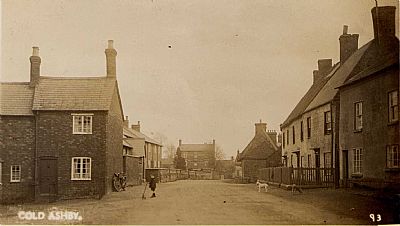
An intriguing postcard (above) of Main Street
The date is uncertain and there is no publisher's name evident, though the card has a postage stamp affixed which commemorates the 'Postal Union Congress London 1929'.
The small cottage in the left foreground now forms part of Bridleway Cottage.
Interestingly, the Memorial Hall (opened 1920) does not seem to have been built - though the porch of a building on the left resembles the present porch of the Hall so the Rambler could be mistaken.
The cottage in the immediate right foreground no longer exists but others have survived including The Forge (though this is not clearly visible). The Bull Inn (now The Red House) has its frontage facing the camera in the background.
Main Street is apparently unsurfaced, and most certainly free from traffic. Also, the only parked vehicle is a motorcycle.
It was obviously a much safer play area for children and dogs than it is now!
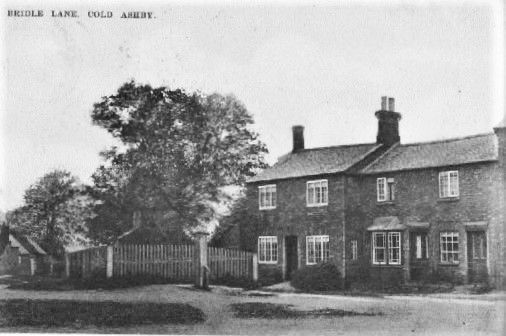
The above postcard of Bridle Lane was kindly lent by Janet and Ted Thompson.
Those familiar with this view will notice that the first cottage on the left (now named 'Grace Cottage') has a thatched roof in this photograph which has since been replaced by slates. Also of interest is what appears to be a mounting stone in the left hand corner. A similar (possibly the same?) stone was still in that position until quite recently but was moved to the corner of the Green when work was in progress on the front of this property and now partially helps to protect the grass from the tyres of large farm machinery.
In Round and About Cold Ashby (p.55) we find the following:
‘Our source recalls that during Frank Beale’s grandfather’s occupation (of this cottage) in the 1880s, the mud wall collapsed into the street and the village held a collection to pay for the subsequent rebuilding.’
This was, perhaps, an early example of ‘Crowdfunding’ - though the Rambler believes the population at that time would have been somewhere between 350 and 400!
It certainly suggests that the people of Cold Ashby had a tradition of caring for the immediate needs of their neighbours.
A view of the opposite side (East) of Bridle lane
Sadly, all that now remains of the splendid pump seen on what is now the centre of 'The Green' is the slab on which it stood. The building just discernible behind the fence is no longer there either.
The Rambler would welcome more information about this mysterious property!
.................................................................................
Dr John Rogers M.B.E. of The Cedars, Cold Ashby
Following messages and information from his granddaughter, Joan, the enquiries kindly made by Ted and Janet Thompson, the co-operation of present and former villagers and some personal research, the Rambler can now supply a few details about the life and career of Dr. John Rogers, who had a surgery at The Cedars in Thornby Road in the 1950s.
The Cedars as it was before demolition in the late 1950s or early 1960s ...
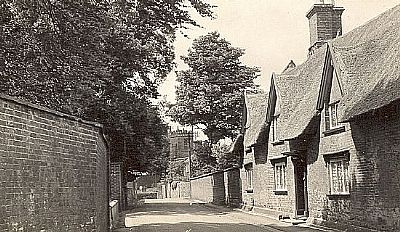
… now all that remains is the date stone (1642 WL). The above photograph is from p.52, Round and About Cold Ashby. It also appears on the Old Ashby Page of The Parish Council Website.
(The following details are believed, though not guaranteed, to be accurate – please contact me if you have any further information or wish to correct errors).
In Cold Ashby Dr. Rogers is remembered as the local GP – a 'not very tall man who wore a Trilby and drove a Wolseley car'.
The Rambler has learnt that Captain John Auty Rogers was born on the 3rd December 1886 in Dinapore. His father died when he was eight years old and he was sent to a military boarding school where he is said to have excelled. He went on to gain a degree in medicine and was a physician at the British Military Hospital at Landour, in the Western Himalayas.
In the First World War John served with the Indian Division in France from the 3rd November 1914. He later became Physician to the Viceroy, Lord Willingdon. He returned to the UK with his wife, Eileen Sophia, at the beginning of the Second World War, serving initially as an army surgeon at Caterham while living in Holland Park in London. He appears to have retired from the army around 1939, having become a Senior Assistant Surgeon and a Captain.
After this, he is believed to have performed surgery at Northampton Hospital – presumably whilst also practising as Cold Ashby's GP.
As a child Joan's sister Eileen, known as 'Sugar', was sent to stay with her grandfather as her mother was unwell. She is remembered by several villagers who travelled on the same bus to school and played with her at The Cedars. 'Sugar' became well-known to T.V. viewers as the actress, Mitzi Rogers.
Joan remembers visits to the Cedars and playing in the garden which was across the road from the house.
Evidence of John Rogers' distinguished army career, qualifications and awards can be found at the following :
Bonhams & London Gazette 3rd June 1936.
Postcards of Thornby Road (dates uncertain)
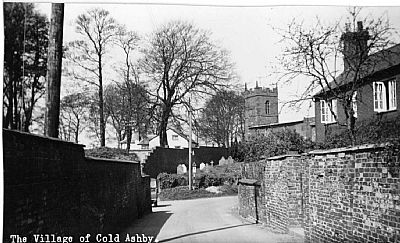
(Landscape View Publishers, Market Harborough )
The above is of Thornby Lane approaching the Church of St. Denys - a handwritten note on the reverse indicates that the card was purchased in 1960.
Of interest here, is the road sign which appears, when enlarged, to be the original school warning 'beacon' - a reminder of the Rambler's youth, when a flaming beacon symbolised the enlightening power of education and, more prosaically, proclaimed a school entrance round the corner!
(If the reader is young enough not to remember this iconic sign, the Rambler recommends clicking here.)
Sadly, both sign and school are no longer functioning – though the school building, featured in the background of the next card below, is now beautifully restored as a private house.
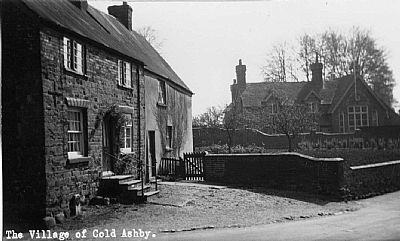
(Landscape View Publishers, Market Harborough )
This, again, is of Thornby Lane - apparently first purchased with the above card in 1960.
The viewpoint here is from the junction with Church Lane (the church being out of frame on the right).
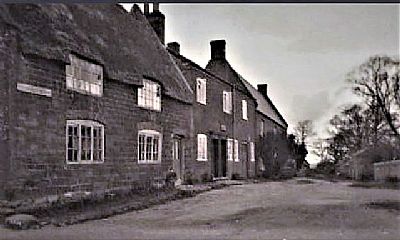
The two cottages in the left foreground are now known as Honeysuckle Cottage and Peg's Cottage.
As can be seen from this recent photo,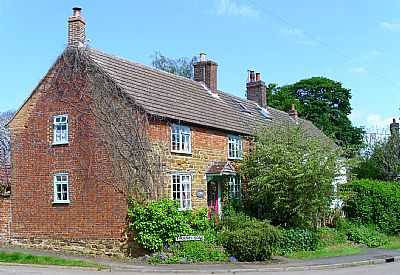 the latter has been much extended and the garden wall is now replaced by hedging. Note, however that the cross-shaped metal 'tie' or patress plate in the front stone wall of the former is still evident (and obviously still effective!).
Also, there are now front gardens to both properties.
Both have had their roofs altered in pitch and tiles have replaced the traditional corrugated iron (probably over old thatch) and both have been most sympathetically renovated.
...................................................................
Many thanks to Ted & Janet Thompson for the following valued contributions to this page (January 2016) :
Some Trivia and A Glimpse of Cold Ashby in 1966 - Fifty years ago
(Pre- Ipods, Tablets or Laptops)
There was a Church, Chapel, Lampshade Factory, School, Shop, Post Office, 2 Bakers, a Butcher, Fishmonger /Greengrocer, Hardware (paraffin etc.) - all delivered.
We had a Mothers' Union, a Women's Institute, a Merry Comrades*(Who danced around the Maypole), a branch of The British Legion (with Thornby), 2 Football Teams, a Bowls Club, a Village Hall and a Public House.
Janet & I delivered the Sunday & Evening Papers (not the Daily Papers). Having found an old paying-in book, it reveals the following approximate results:
There were about 69 dwellings of which 5 or 6 were vacant or in need of renovation. We also delivered to 7 lodges - so from 71 houses we delivered to 62 with ‘Sundays’, 34 evening ’Chronicle & Echo’, 23 weekly 'Mercury & Herald’ and 28 Sports ‘Green 'Un’ on Saturday at 7.30 pm. 27 people were involved in agriculture, 9 of these either owned or rented a farm or smallholding.
We can’t recall anyone going to their place of work further than Northampton or Rugby. The only exception was the man who lived at the Old Vicarage, who was Chief Planning Officer for the City of Leicester, one of the first in the Country. ( Google:- Konrad Smigielski )
*For information about 'The Merry Comrades' click here.
Cold Ashby Women' Institute Program 1967
......................................................................................................
Cold Ashby Memorial Village Hall
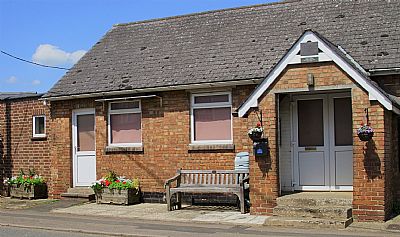
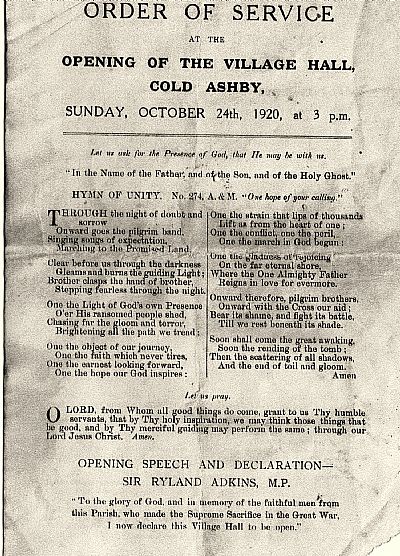
As can be seen on this copy of the Order of Service, the hall was opened by Sir Ryland Atkins M.P. on 24th October 1920. It was built by Gus Bott and Tom Letts, with funds raised in Cold Ashby, on land given to the village by Stephen Matthews.
In 1922 the Hall, then called the War Memorial Hall because of its original purpose, was transferred to the ownership of Cold Ashby Village as a games and billiards room for men 'of the artisan and labouring classes'.
(the above is from Cold Ashby Parish Council's Village Hall Page where further details of the deeds can be viewed).
Today, through a process helpfully explained at the above link, the hall does not suffer from such archaic restrictions and is available to all, regardless of gender or occupation.
[Order of Service at The Opening of The Village Hall (Arlidge & Son, Printers, Northampton) -
kindly lent by Janet & Ted Thompson]
Below are the Memorial Plaques which can be seen above the entrance to the Hall
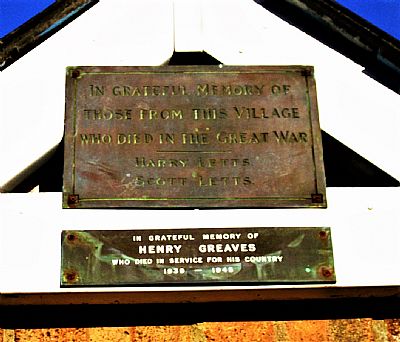
The inscriptions read:
In grateful memory of those from the village
who died in the Great War.
Harry Letts*
Scott Letts*
In grateful memory of
Henry Greaves*
Who died in service for his Country 1939-1945.
**For a very well researched and detailed page on Harry and Scott Letts and their families the Rambler strongly recommends this blog post.
* See this blog post for more information on Sgt. Henry Greaves
*The Memorial Hall is registered by the Imperial War Museum - see this link
Men and Women of Cold Ashby who served in the two World Wars.
First World War
Sap Horace Archer
Pte Walter J. Archer
Pte Edwin James Beal
Pte John Beal
Pte Francis Bott
Pte G. Augustus Bott
Pte Frederick Bott
1stClBoy Raymond Cave
Gun Walter E. Cave
Pte Albert John Clark
2ndLieut Sidney Gardner
Pte Alfred Garrett
Pte T.H. Gardner
Sap William C. Gaunt
Pte Ernest Garrett
Pte Alfred E. Gunn
Pte Ernest C. Green
Pte Wm. Arthur Gunn
Pte Harry Gunn
Pte Alfred Letts
Pte John A. Hardstaff
Pte John Letts
Pte Harry Letts
Pte Scott Letts
Pte Samuel Letts
Pte Tom Lee
Sap Thomas S. Letts
Pte George Linnell
Sgt Tom Lill
Pte William Porter
Pte Charles W Marlow
2ndLieut John Wm. Slater
Gun Albert E. Sadler
Pte AlbertYork
Pte Charles Smith
Pte WalterYork
Second World War
Gun William A. Adler
F/Cpl Frederick Barnett
AB John P Barr
Pte Frank R. Beal
Sgt Clifford G. Bott
Pte Harold E Bott
LAC Eric L. Cheney
Sap H. John Cave
MstatArms W. Charles Cave
ColSgt W. Leslie Cave
WRNS Eileen Godfrey
Sgt Henry Greaves
Gun Reginald E. Green
LAC Ashley E. Judge
L/Sgt William Lee
Pte Douglas Letts
AB Donovan K Lill
Sap Edward Marlow
Pte Florence Massie
Sap James Massie
Sgt Charles W. Smith
Cpl Larry Spollen
Pte Albert E. Whiting
Maj Peter M. Wiggin
Pte Joan B. Worth
..................................................................................
Cemetery Corner
A Continuing Historic Hazard
[Harborough Mail (date unknown)]
The Rambler’s thanks go to Ted Thompson for the loan of two historic cuttings from the Harborough Mail and Northampton Chronicle and Echo.
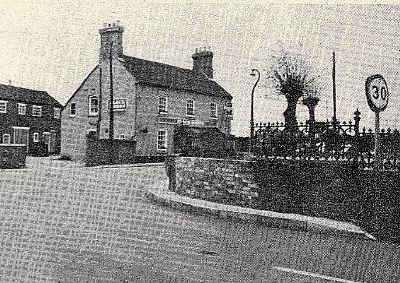
The Harborough Mail, highlights the perils of the ‘absolutely blind corner around the graveyard’ and the damage done to the retaining wall of our cemetery and the threat to The Red House opposite from ‘large lorries, whose drivers seem least able to cope with the sharp and (for them) near impossible turn’. The exact date of this article is uncertain but is believed to have been submitted over 40 years ago!
The Chronicle and Echo piece, headlined Link may hit ramblers rights, is a report on the lengthy public enquiry (probably that of 1984) into what was then the proposed ‘M1- A1 Link Road’, later to become the A14 that we all now know and love.
It focuses on the concerns of the Ramblers Association that access to the ‘ attractive landscape in Northamptonshire’ would be adversely affected but also mentions ‘a spokesman’ from Cold Ashby who said that “a particular hazard was a dangerous 90-degree bend called ‘Cemetery Corner’ - the cemetery wall has been demolished five times in the last six months by heavy goods vehicles.”
According to Round & About Cold Ashby the ‘ kerb was raised at cemetery corner to try to stop damage to the wall’ in 1974 and the ‘remainder of the iron railings removed’ in 1975.
But the hazardous history of cemetery corner is certainly not complete.
Despite the imposition of a 7.5 T weight restriction in Cold Ashby heavy lorries still illegally attempt the corner with similar results and the increase in traffic resulting from the poor planning at the Catthorpe Interchange means that the corner is now probably more dangerous than ever.
For an up-to-the-minute assessment of the situation and pictorial evidence the Rambler strongly recommends this link:
http://bypasscoldashbynow.com/overweight-traffic
Foot and Mouth Restrictions in Cold Ashby, 2001.
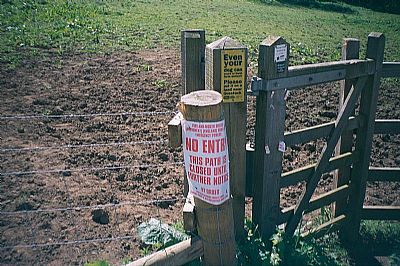
Photo by Wipsenade [CC BY-SA 3.0 (https://creativecommons.org/licenses/by-sa/3.0)], from Wikimedia Commons.
The Rambler, has discovered an article from the Daily Telegraph, of 10th March 2001 which includes a report that highlights the apparently insurmountable challenges which the government’s imposition of a ‘disease control area’ could create.
Yet, it also celebrates the resourcefulness of local farmers and businesses and the spirit of co-operation operating locally in dire circumstances.
From the article we learn that Cold Ashby farmer, Phil Bott, was supplied with a marquee by a company in the nearby village of Crick, enabling Mr. Bott to provide shelter for his ewes at lambing time.
Mr Bott has recently explained to the Rambler that he was unable to get sheep to the more conventional shelter because of the restrictions on movement.
He thanked those who had helped with gifts of lamb and beer!
.............................................................................................................
The Village in the Early to Middle Twentieth Century
The Rambler is, again, indebted to Ted Thompson of Cold Ashby who recently discovered some papers from which I have extracted these (lightly edited) written memories, possibly recorded by long term residents during research for the Parish Appraisal which led to the publication of Round & About Cold Ashby, completed in 1995:
… a village of around 400 inhabitants, 10 miles from the nearest market town. Families with anything up to 12 children living in tiny houses, some only "one up, one down" rented at 18 pence a week, with as little as a £1 a week coming in. But a community held together by need and friendship with each family doing their bit to maintain the needs of themselves and their neighbours.
Many of today's inhabitants were children then and have vivid memories of life in harder times. The village was practically self- supporting and boasted many farms and small holdings, two public houses, The Black Horse and The Bull Inn (where beer was sold at 3 pence per half pint) two bakers, a blacksmith, a cobbler, a carpenter (who also made coffins) a butchers shop with a slaughter house behind, and three shops, one of which was the Post Office, the other two were general stores selling everything from boot black to lucky bags.
The children earned pocket money after school by doing chores, fetching water from the well or from the few pumps sited around the village, though the well water was thought to taste better. One had the job of pumping water into a tank at the vicarage where there was an indoor tap. Fetching milk from the smallholding, morning and night for various neighbours, getting in he coal and sticks for the fire, blacking the grate, cleaning out the hens, running errands, scrubbing the lavatory seat, and many other household tasks, for which they were paid between 1 and 3 pence per week...
… The school was a hive of activity with around 40 pupils. There were two teachers: one for the older children and one for the little ones. Plays were performed by the children throughout the year with a Nativity at Christmas. Much excitement filled the school on these occasions, with costumes made from crepe paper and oddments of material. Hand bells were the musical accompaniment to the choir and all the children had lots to learn and do. At the end of each school year, the children with the best attendance received a guinea from the governors. At the age of 11 the children moved up to the school at Thornby.
...The Sunday school trips were something the children looked forward to with delight. Some, simple picnics held at Honey Hill just outside the village and in later years visits to Wicksteed Park on a bus...
… At one time the Church Army had a caravan in the gardens of the vicarage, the people of the village fed the army and they were allowed to sleep in the school room. After school the children of the village would go along to the caravan and sing with them: "What a friend we have in Jesus" was a popular hymn.
A day off was granted on hunt day so the children could follow the hounds.
The owner of Thornby Grange invited children from Thornby and Cold Ashby to a Christmas party. The state of her highly polished floor after much sliding down bannisters etc. may well have made her regret her generous gesture!
The men found work on the farms and smallholdings, some went further afield to work for builders and some went into service as hall boys, butlers and stable-lads. Those travelling away for work either walked, pedalled a bike or used a pony and trap...
… The young girls, who had left school at the age of 14 would look for work as maids (at £18 per year) nursery nurses, housemaids (5 shillings a week) … some managed to be trained as nurses at hospitals in nearby towns.
In the 1914-18 War 36 young men left the village to fight in the trenches and 3 were killed. The Second World War saw 25 men go into Military Service and all except one came back. The women kept everything going, not only doing their own chores but doing the things their menfolk had as well. A few landgirls came to help out – some of whom never went back and still live in the village. Many children were evacuated from London to village homes… The women worked hard on the war effort and each soldier was sent 10/- a week along with scarves, gloves, pullovers, letters and goodies from home. On their return, the whole village had a great celebration and each soldier received £20 as a gift from the village.
In 1930 great excitement was caused as the Airship R101 flew over Cold Ashby on its preliminary trials before flying off to India. This journey was never completed as the Airship crashed killing a great many people...
The first meeting of the Women's Institute was held on 26th May 1930 at the Village Hall and boasted 26 interested ladies. The June meeting had swelled the numbers to 43 and so the W.I. was established for the women of the village along with The Mothers' Union.
...In 1934 there was an epidemic of Scarlet Fever which was contracted by young and old alike. Few people managed to escape this unpleasant disease. Many were taken into the care of Staverton Isolation hospital some 16 miles away…
... In 1947 Cold Ashby was snowed in for 4 days … snow was up to some of the bedroom windows of the cottages...
... The Queen’s Coronation in 1953 provided the ideal opportunity for a colourful celebration and houses and village streets were decked accordingly. The best dressed house was a fully fledged Golden Coach. Much fun was had trying to throw a streamer of red white and blue flags from one house to the house opposite. The celebrations included a children’s party with fruit salad served from a milk churn. Fancy dress was great fun and everyone was encouraged to do a party piece, which the under tens did with relish as payment was a whole sixpence, a small fortune. Sports and games continued well into the evening – a great day was had by all…
...The thing that has changed most of all is the volume of traffic… a far cry from the days when one would see cows passing down the main street twice a day for milking and on Sundays villagers could be seen making their way to the local baker with a joint of meat in a tin with Yorkshire pudding mix in a jug – the baker did the rest. Sometimes the end result resembled the oven it was cooked in and it was not uncommon to end up with someone else’s dinner…
... Although ‘cold’ by name, Cold Ashby is still a warm and friendly village.
...............................................................................................
If you have any further information or enquiries, or just wish to share an interest or memories, please use the Guestbook or Contact page.
Thanks for your interest.

Back to Top

